
Addition by subtraction

In discretionary trading, most of the attention goes to developing a winning strategy and a positive edge. Although that is fundamental to success, far less effort is spent on removing the negative edges that arise from human weaknesses and ingrained biases. If you are a trader who has achieved some success but still suffers drawdowns that are longer and more frequent than you would like, the key to leveling up may lie in reducing your negative edges rather than improving your positive ones. The best part is that this approach does not require you to add anything new to your strategy. By subtracting, you add to your P&L.
In this post, I discuss how I used journaling to identify the negative edges that held my trading back and how I systematically reduced them. Doing so shortened and shallowed my drawdowns, which allowed my positive edges to contribute more to my overall return.
What is negative edge, exactly? I define it as mistakes, habits, or biases that prevent you from executing your process or turn a winning strategy into a losing one. Examples include:
Taking profits too early because of loss aversion
Widening or canceling stops too often and letting losses get out of control
Frequently cutting loses before the market reaches your stop (abandoning your original plan)
Not protecting your profits and allowing gains to disappear or turn into losers
Overtrading out of overconfidence or boredom
Taking low conviction trades where you have no discernible edge
Sizing your positions too large or too small
Placing stops that are too tight or too wide
Fighting the trend or the tape (shorting into a strong market or buying into a weak one)
Buying overbought markets and selling oversold markets too often
Entering trades based on FOMO
Revenge trading, or trading on tilt
Having a market bias that is not grounded in reality (such as always being bearish equities)
The list is long, and this is only a sample of the ways traders trip themselves up.
Journaling your trades is a basic requirement if you want to collect data on the mistakes you make. In my journaling software, I maintain a checklist of 18 mistakes I commonly commit. Whenever I make one of them, I tick the box when I exit the trade and complete the journal entry.
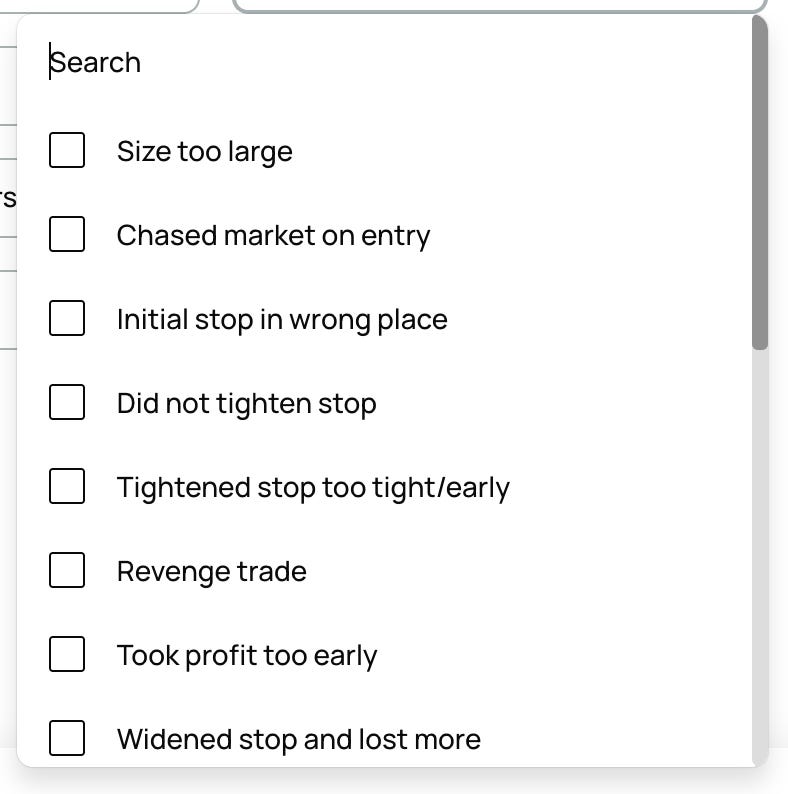
Over time, this lets me measure how much those mistakes cost. Before I started this process, my most common errors were failing to stick to my stop losses and failing to protect profits. I am generally an optimistic trader, confident in my views and abilities, so I often talked myself into giving trades more “breathing room”. The data showed that this hurt me far more often than it helped. My largest losing trades sometimes lost several multiples of 1R. If they had been limited to 1R or less, my profitability would have been significantly higher.
Once you identify which mistakes are causing you the most problems, it’s not enough to simply tell yourself “Do better”. You need to encode the solution into your process. In my case, I decided that immediately after opening a trade I would always enter an automatic stop-loss order into the system. I told myself that if I get stopped out, I can always give the trade another chance by re-entering with a new stop after reevaluating it. I also began trailing my stops more frequently once a trade became profitable. These changes, once implemented, contributed meaningfully to my profitability.
Some common mistakes do not stem from flaws in process but from flaws in psychology or mindset. For example, some traders dig deeper holes by revenge trading or going on tilt. This usually reflects a mix of factors, such as an inability to emotionally accept losses or holding a deeply ingrained view that prevents them from getting back in sync with the market.
Other traders handicap themselves with strong directional biases that keep them trading only one side of the market, or they insist on expressing a view in a single market while ignoring others. Many global macro traders, for instance, have a persistent bearish bias because their formative years were shaped by the 2008 GFC or the 2000 dot-com bust. Many crypto traders lean the other way and maintain a persistent bullish bias because they live in the bullish echo chamber of “crypto Twitter” and their industry peers.
These biases create frustration, P&L losses, and opportunity costs. Equity markets spend more time going up than down, while crypto markets spend more time going down or moving sideways than up. Having traded through both major equity bear markets, I struggled with an overly bearish bias well into the second decade of my trading career.
The key to overcoming biases is self-awareness and a deliberate effort to look for setups on the opposite side of your usual stance, and then actually take those trades. Every trader has to confront the psychological tendencies that cause the same mistakes to surface again and again. Family history might lead one trader to extreme risk aversion, causing him to take profits too early, while another trader’s addictive personality may push him to chase dopamine hits by overtrading. Working through these biases and mistakes can become a rewarding journey of self-discovery and personal growth.
Related links:
