
Still cautious

Since my last post, when I spoke about the topping of the AI super-cycle, we’ve seen a rapid deescalation of the war in Iran and the implosion of Leopold Aschenbrenner’s fund Situational Awareness. The fire sale of Aschenbrenner’s public equity portfolio to Citadel has led the market to believe that the AI semi’s trade has bottomed.
The implosion of Situational Awareness is the perfect example of how leverage can destroy the smartest of investors. I feel tremendous respect for Aschenbrenner, as he had the vision to lay out the AI scaling roadmap in his 2024 essay Situational Awareness1, and had the audacity to raise a fund to put money behind the vision. He was early to the AI semis boom and made tremendous returns, but it was the unnecessary 4 to 1 leverage backing his trades that was his undoing. Fortunately, Aschenbrenner is only 26 years old and has plenty of time to learn from his mistakes, so I’m sure this won’t be the last that we will see from him.
The recent developments have resulted in a powerful rally to new highs in the S&P 500, while the recovery in SMH has yet to recover much of the ground it lost in July. I’m currently contemplating two scenarios for how the bull market in SMH and the broader market will unfold.
Scenario 1 (my current view) - SMH made an absolute top in June while the S&P 500 bull market continues for another 3 to 9 months.
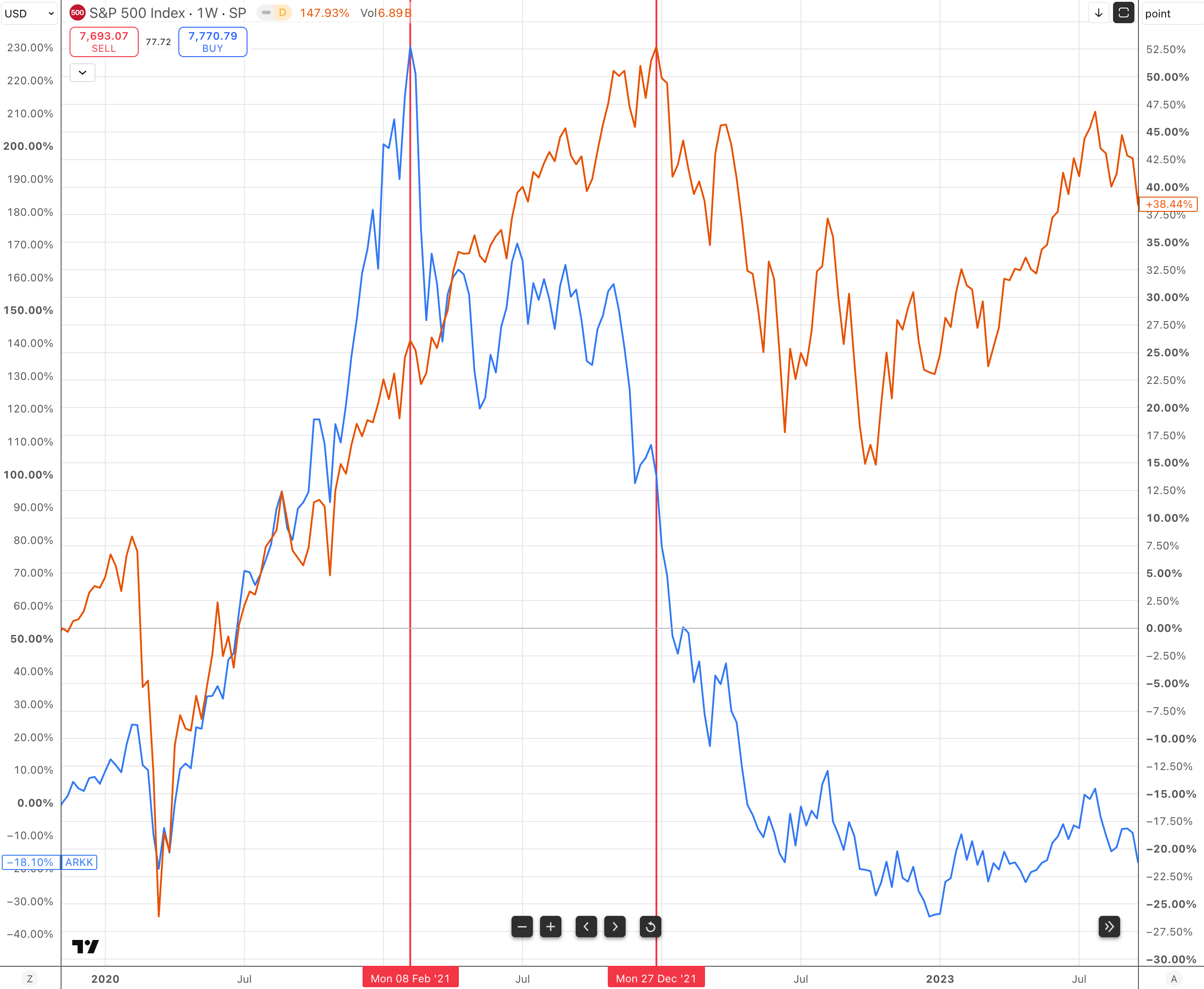
This would be analogous to 2021, when ARKK peaked in Feb 2021 while the S&P 500 peaked in December 2021…
…or analogous to 2000, when the Nasdaq peaked in March while the S&P 500 made its second peak in August.
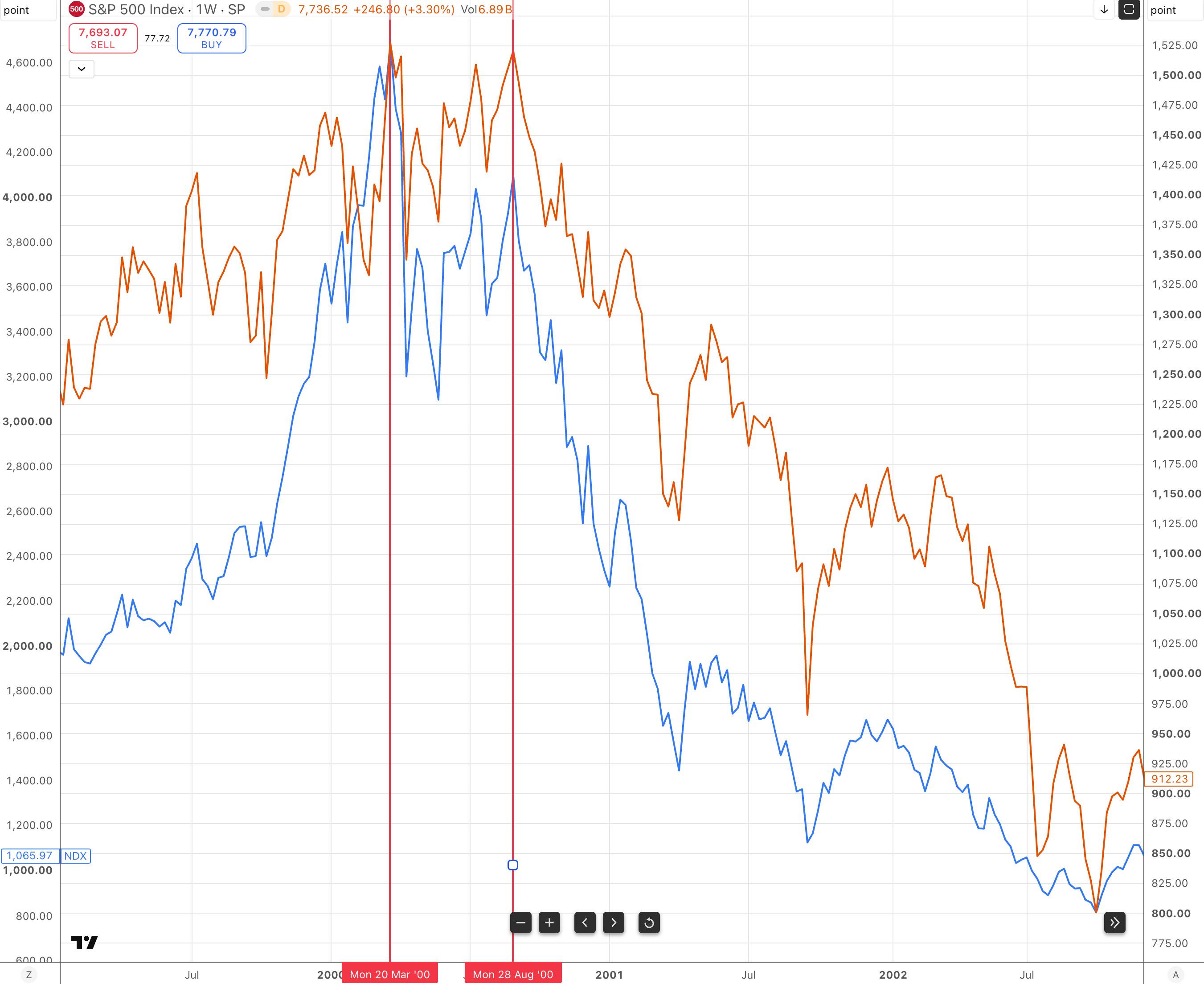
The reason why the S&P 500 continues to make new highs despite the leaders peaking is because capital broadens out of the leaders and into other areas of the market that have been overlooked. In today’s case, capital has left AI semis and rotated into the hyperscalers, which have been trading sideways for a while due to concerns about over-investment into data centers and declining free cash flow.
Scenario 2 - June was a local top in SMH, and some digestion and sideways price action occurs before new highs are made later this year or early 2027.
This scenario could play out if there are no more global macro shocks (such as another flareup of the war in Iran) and if AI revenues at the model labs hold up despite the assault on margins by Chinese open source models. If I change my view to scenario 2, you will be the first to read it here.
The reason I’m sticking to scenario 1 right now is because of the looming risk of decelerating revenues at OpenAI and Anthropic, which would hinder their ability to raise further capital and make good on their future financial commitments to lease or purchase compute.
ARKInvest illustrated that the cost-per-performance at a fixed point on their proprietary model benchmark DeepSWE declined by 99.9% since Sonnet 4.6 in February and estimated that cost-per-performance should drop by 99.96% over the next year. In addition, the slope of the performance-to-cost curve is flattening by 2x per year, which means that the additional cost to get an incremental improvement in performance is declining rapidly.2
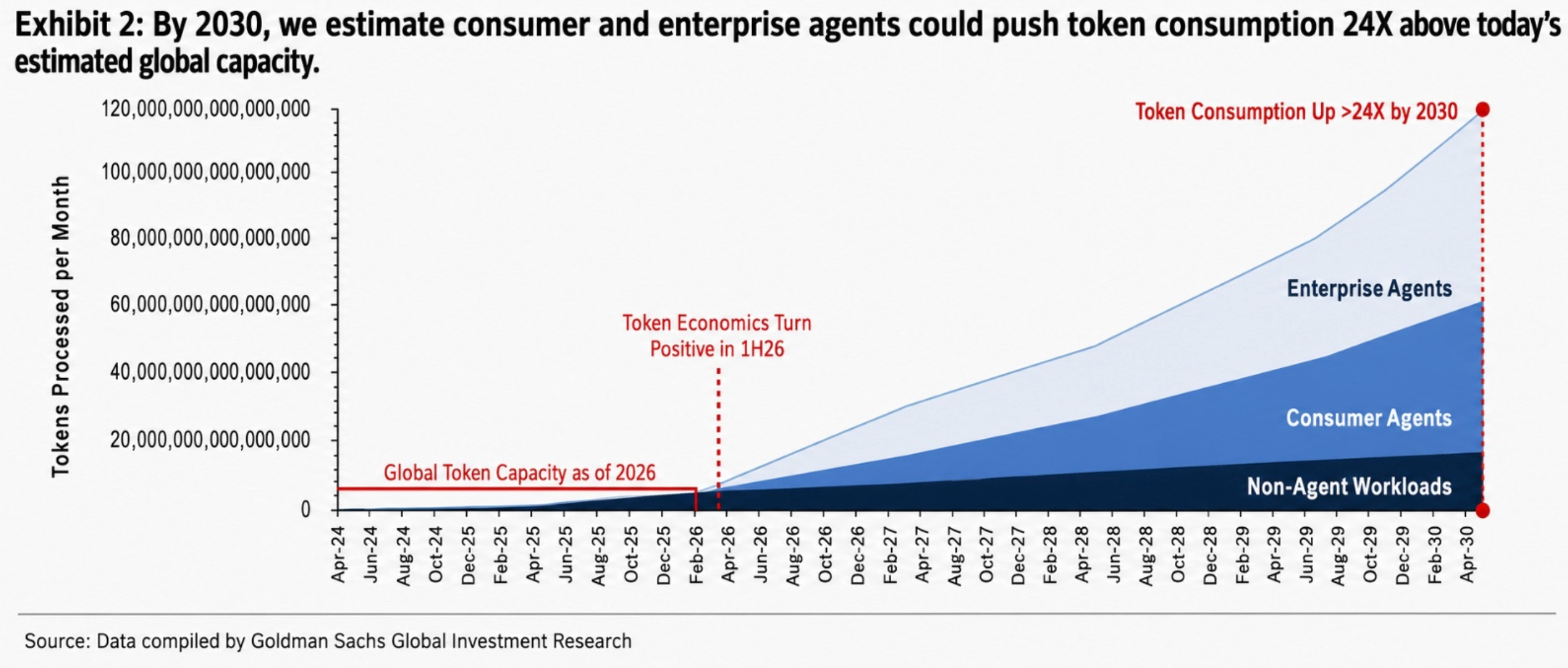
Meanwhile, Goldman estimates that consumer and enterprise agents may push token consumption higher by 24x by 2030. This is rapid growth indeed, but it doesn’t keep up with costs that are declining even faster.
If the bullish scenario 2 is to occur, it would need to be within a window that is slowly closing. Based on recent estimates by BofA, capex spending is expected to decelerate from 80% YoY in 2026 to 38% in 2027 and slow further in 2028.
AI bulls argue that cheaper intelligence from open-source and Chinese models should be bullish for compute as it will result in a Jevon’s Paradox-fueled explosion in token consumption. In theory, that works only if demand for compute is spread across many well-capitalized customers with robust financing.
In the world we actually live in, OpenAI and Anthropic account for an estimated 70% of the AI revenues at Google, Amazon, and Microsoft. This estimate is based on analyst Ed Zitron’s recent post (paywalled) that uses estimates from Barclays and UBS to triangulate this number.
What hyperscalers have actually done is demolish their free cash flow and purchased hundreds of billions of dollars’ worth of GPUs, TPUs, and XPUs to support a customer base dominated by two customers that are now accounting for the vast majority of their revenue growth and quite literally cannot afford to pay their bills without a near-infinite flow of venture capital investments.
Zitron also points out that a large source of hyperscaler revenues are coming from themselves, via their investments into OpenAI and Anthropic:
Every publication you read right now will tell you that AWS and Azure and Google Cloud are growing like wildfire as a result of the hundreds of billions of dollars they’ve invested in AI GPUs and data centers, when the truth is far simpler: their revenues are being buoyed by two unprofitable, unsustainable AI labs that cannot exist without being funneled tens of billions of dollars each year.
And a decent chunk of that money is coming from the hyperscalers themselves. In the last seven months alone, Google has sunk $10 billion (and up to $30 billion more) into Anthropic, with Amazon funnelling $5 billion to Anthropic within a week of that investment and a total of $50 billion into OpenAI. For all the concern about circular financing in the AI world, it’s astonishing that so much attention has (rightly, to be clear) centered on NVIDIA’s backstopping and funding of neoclouds, and less on the fact that hyperscalers are propping up their now biggest customers, giving them cash that will eventually migrate back to the hyperscaler.
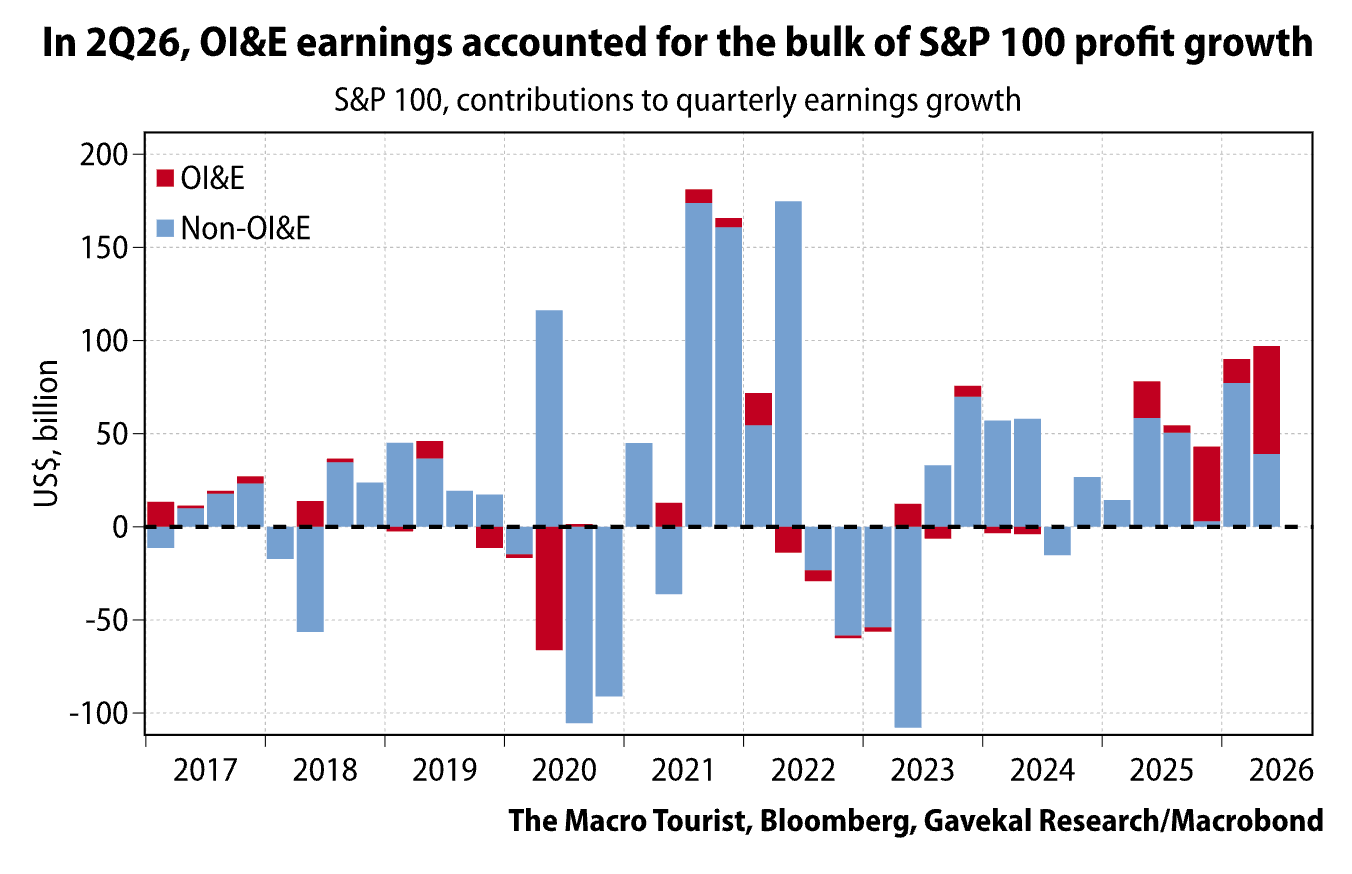
Equity market bulls point to the fact that earnings have been the driver of this recent bull market. What many investors don’t realize is that over half of these earnings come from the OI&E (Other Income & Expenses) category of earnings, which is composed of marked-to-market gains and losses of investments on corporate balance sheets. Kevin Muir highlights an example:
This reporting period, Google announced a $98 billion gain from SpaceX and Anthropic mark-to-market.
Google itself earned about $2.90 per share when it came to GAAP, but the actual amount to hit the S&P indexes was $9.11 a share!
So the 2026 Q2 EPS went from around $82 per S&P 500 share to $92 after Google’s earnings report, yet more than $6.50 of that increase was just Google marking their SpaceX and Anthropic to market!
Research from Kevin Muir and Gavekal illustrates that once you strip out earnings from OI&E, you get a more accurate reflection of what the businesses are earning, and it looks much less impressive.
The same hyperscaler dollars are getting rehypothecated throughout the entire AI complex - directly in the form of spending on compute and indirectly in the form of future commitments and marked up valuations. All it takes is a not a decrease, but merely a deceleration in the ARR of OpenAI and Anthropic that could trigger a reflexive downward cascade onto hyperscaler revenues and the semiconductor supply chain companies that are the beneficiaries of the capex spending. The large amount of debt that hyperscalers have taken on to fund their capex will potentially add further fuel to the fire. The Nikkei reports that Google, Microsoft, Amazon, Meta, and Oracle have an additional $1.65T in hidden debt, on top of the $1.35T of debt recorded on their balance sheets!
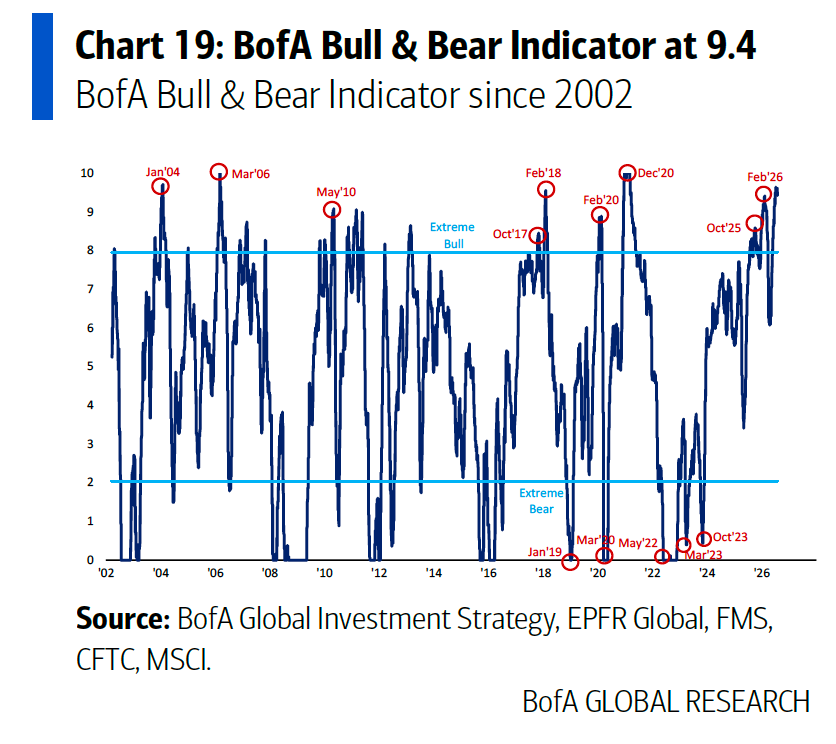
Not only am I unconvinced by the rotation of capital into hyperscalers, I’m also worried about how bullish and long investors are on the broader market. BofA’s Bull & Bear Indicator shows an extreme bullish reading of 9.4, even after July’s selloff in AI stocks.
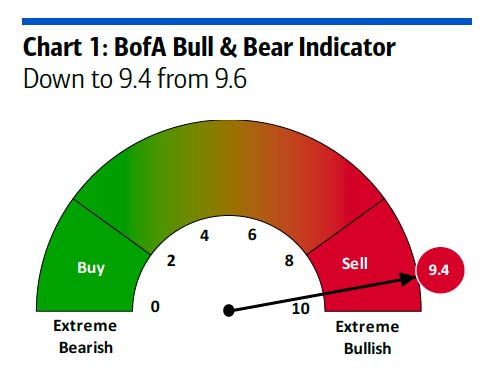
Historically, this level of reading shows up before market tops or corrections.
Let’s also not forget that the current US-Iran-Oman agreement only lasts for 60-days and could fall apart any time (just as the last one did). These agreements do not resolve fundamental differences between the US and IRGC and merely kick the can down the road.
A bottom in precious metals
Futures positioning, open interest, and price action point towards washed out positioning and apathetic sentiment in precious metals. My favorite chart comes from Sentimentrader’s Optix Index3, which shows the largest cluster of readings below 35.9 in the history of the index.
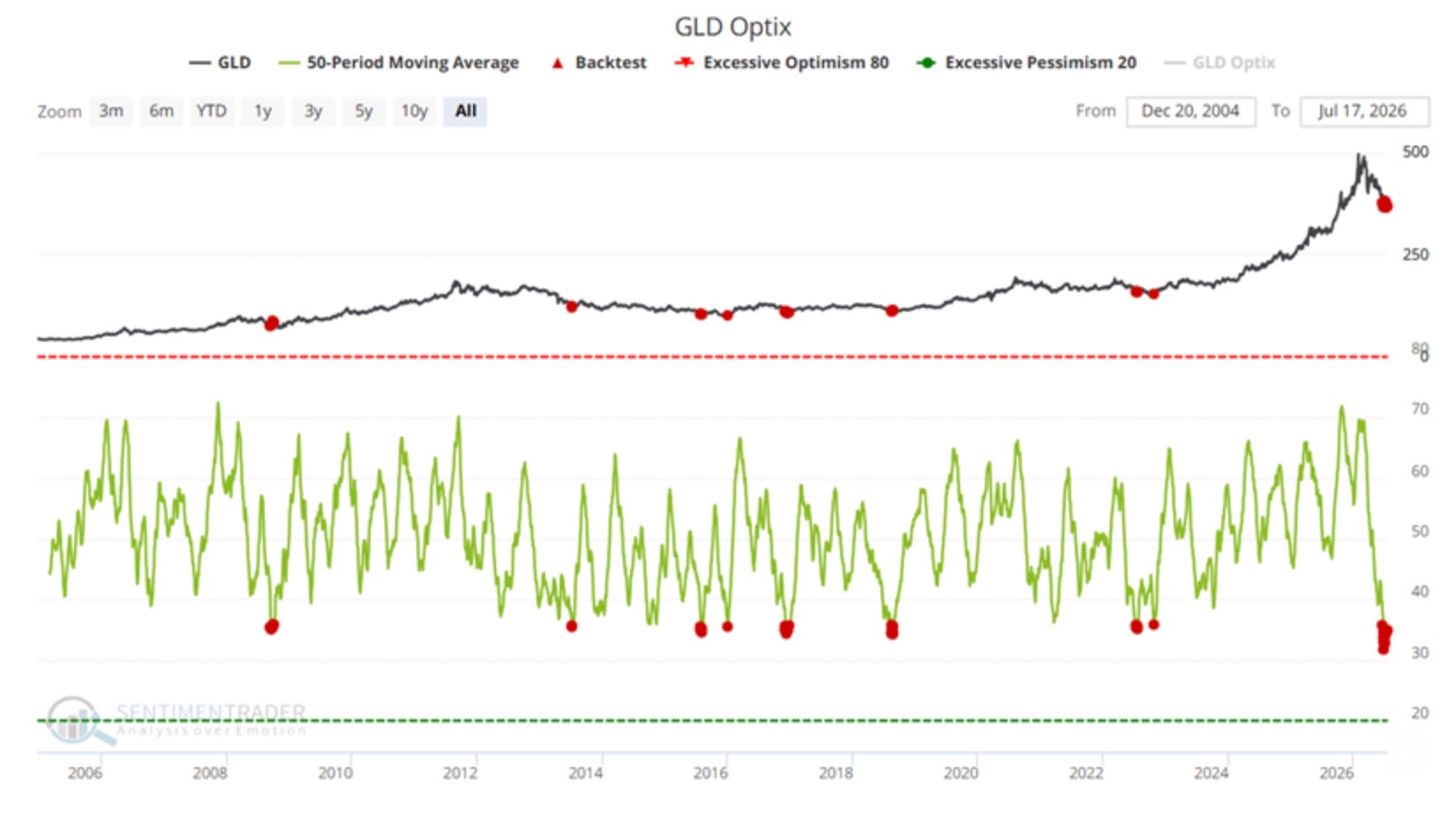
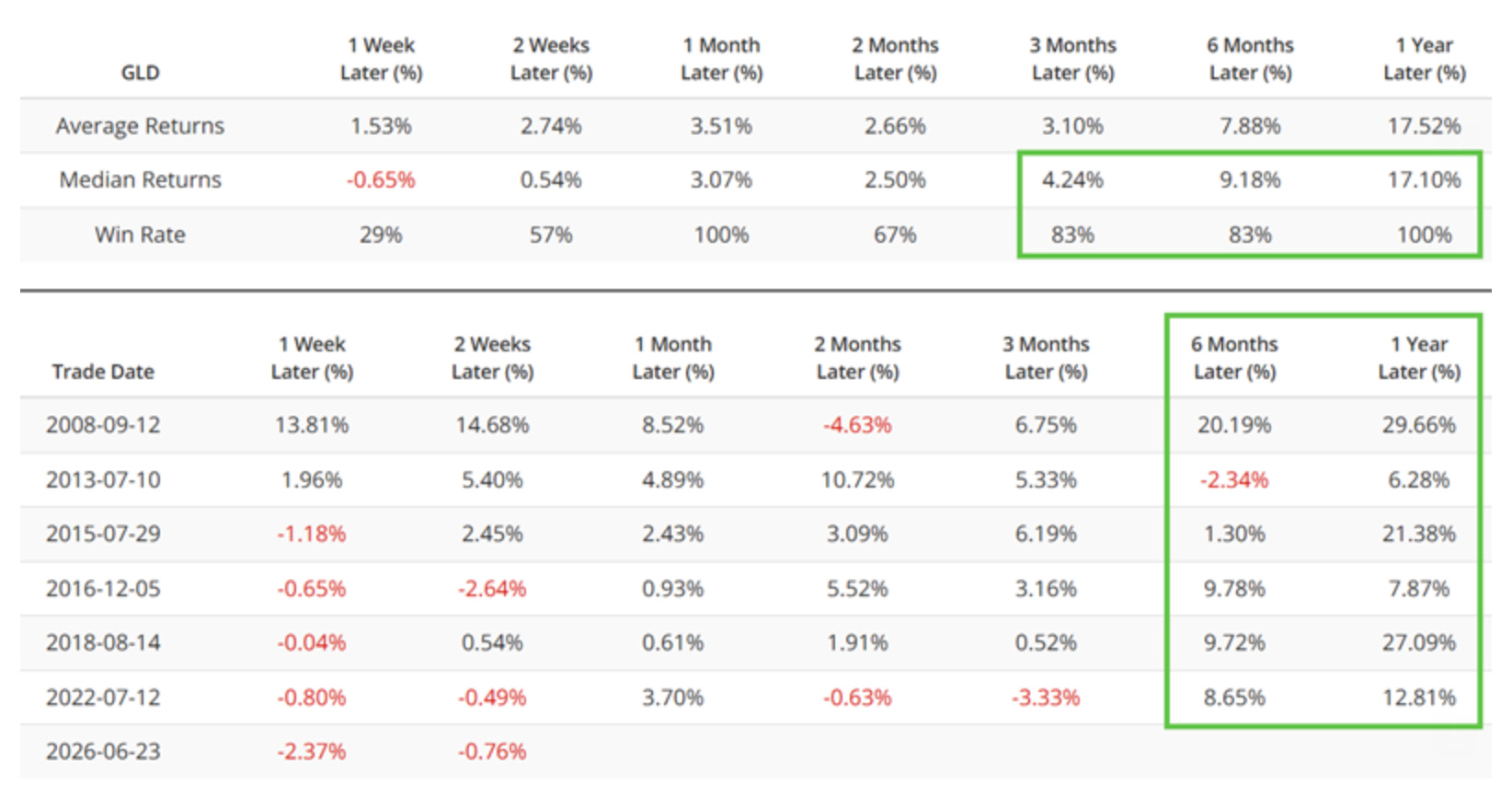
Previous occurrences have been bullish on a 1 month to 1 year time horizon:
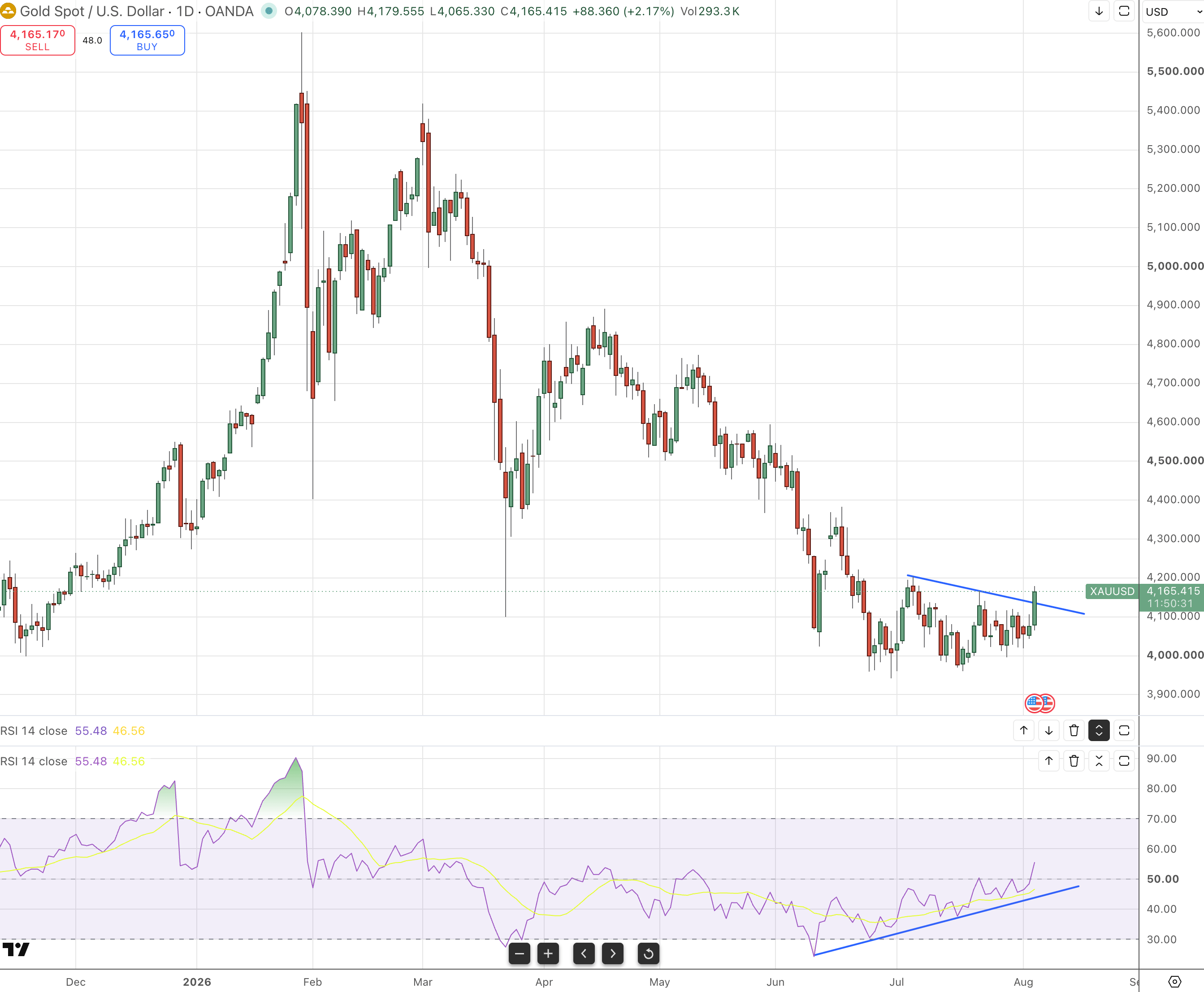
The gold chart looks like it’s about to break out of a base:
And so does silver:
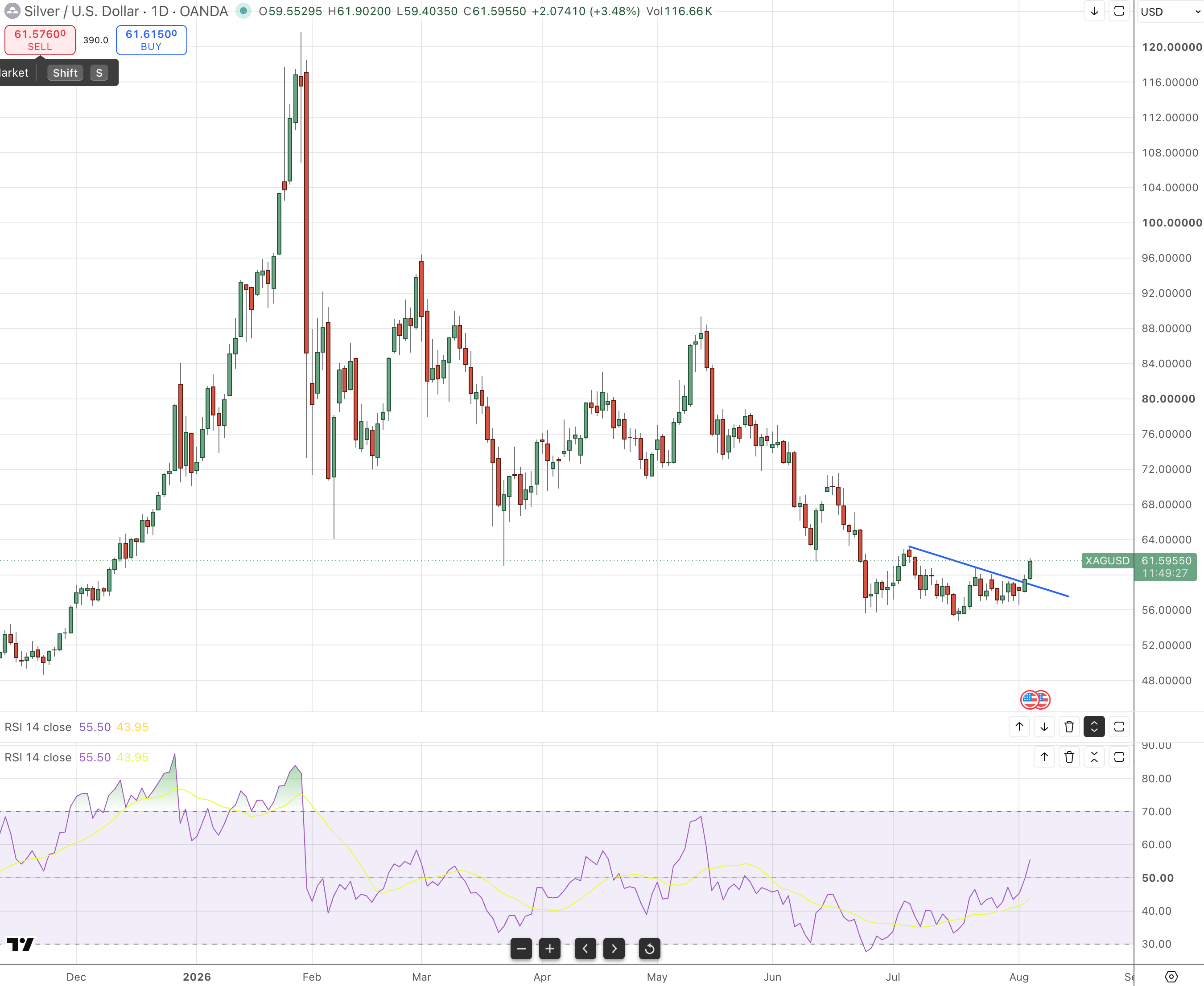
Cross-asset relative price action has also been encouraging. The war in Iran sent oil, USD, and US yields to local highs in July, yet gold and silver held their lows.
Chinese retail have flipped from being sellers to buyers again:
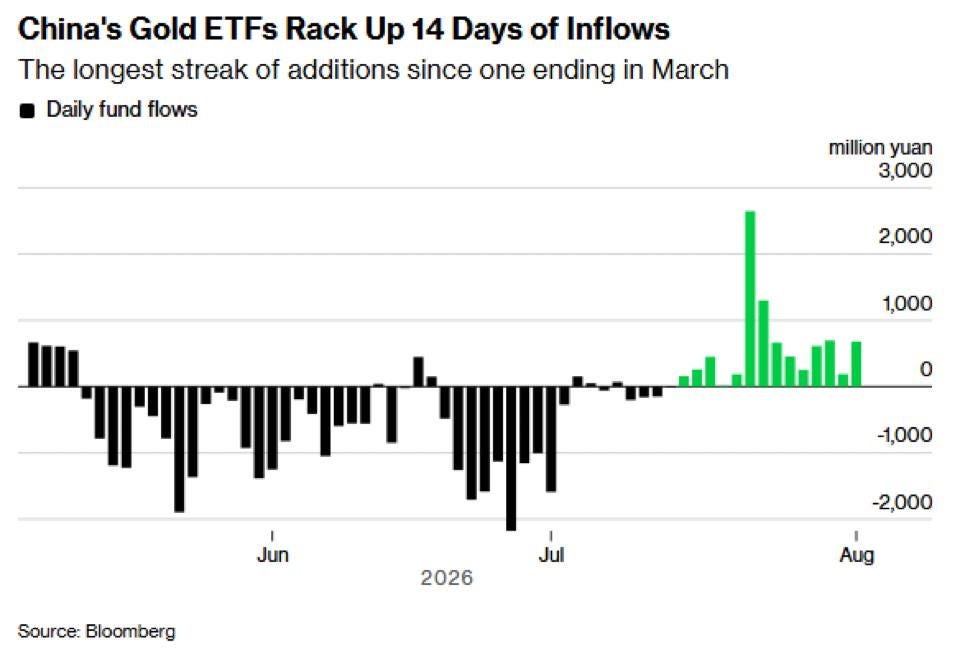
I’m accumulating GLD in my long term portfolio. I’m not expecting the gold bull market to resume immediately, but 4000 in spot may end up being the bottom of a 12-24 month base.
In the paid subscriber section, I’ll discuss current and new futures positions in precious metals, rates, and soft commodities, and how I see those markets developing in the short term.
