
The Final Battle

Will make this a quick one today, as we are in the eye of the storm between Monday war volatility and the FOMC tomorrow.
BCA Research made available their Hormuz Crisis Dashboard. Highly recommend bookmarking it:

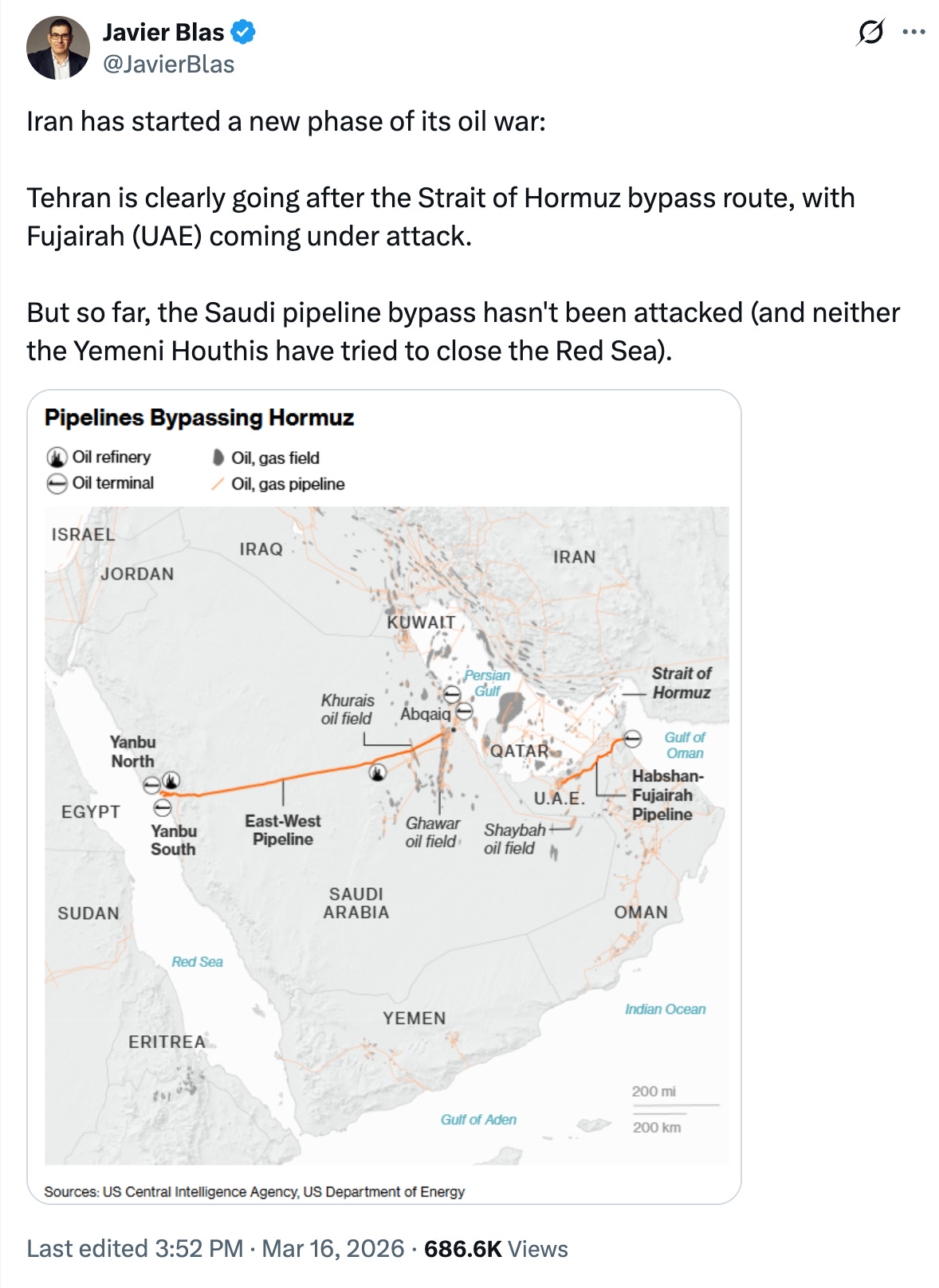
With the few projectiles that Iran is firing, they are targeting the Strait of Hormuz bypass route that allows 7mbpd bypass the SoH via the East-West pipeline. If they successfully damage it, that would be very bad for oil supply.
The best thing I read today was Ray Dalio’s take on the US-Iran conflict. Trump probably understands this and that’s why he’s not going to TACO anytime soon. In order to resolve the conflict, he needs to go deeper and achieve the main objective of securing the SoH:
My reading of history and sense of what is now happening leads me to believe that if the U.S. were to lose in this way, there would be a significant risk that losing control of Hormuz would be for the United States what the Suez Canal Crisis was for Great Britain (in 1956) and analogous defeats were for the Dutch Empire in the 18th century and the Spanish empire in the 17th century. The pattern of events that leads to the breakdown of empires is almost always the same. While it is covered much more comprehensively in my book Principles for Dealing with the Changing World Order, I can tell you here that there are innumerable cases in which a perceived lesser power challenges the leading world power over the control of a critical trade route (e.g., Great Britain's control of the Suez Canal being challenged by Egypt). In these cases, the dominant power (e.g., Great Britain) threatens the lesser power (e.g., Egypt) to open the route, and everyone watches and shifts their approaches to these countries and where their money goes based on what happens. This decisive "final battle" that determines the winners and the losers and whether the empire survives or falls reshapes history because people and financial flows quickly and naturally run from the losers. These shifts affect markets, especially the debt, currency, and gold markets, and geopolitical power. Seeing so many analogous cases led me to the following principle: * When the world's dominant power that has the world's reserve currency is overextended financially, and it reveals its weakness by losing both military and financial control, watch out for allies and creditors losing confidence, the loss of its reserve currency status, the selling of its debt assets, and the weakening of its currency, especially relative to gold.
Read the rest here.
