
July 2026 - A turning point in the AI supercycle

March 2000. March 2008. January 2020. December 2022. Certain months stand out in my memory as turning points that preceded violent upheavals in markets. I believe we will look back on this past month in the same way.
After getting out of my AI semis and infrastructure portfolio in June and moving to cash, I gave myself a well-deserved break from the markets so that I could enjoy the summer holidays. I expected a quiet summer with sideways trading and few opportunities.
That view turned out to be completely wrong.
Everything that has happened over the past month now leads me to believe that the bull market in equities has topped. I’m usually an optimist so this isn’t a conclusion that I arrive at lightly. Unfortunately, developments in AI, the war in Iran, and the Fed are converging to bring about stagflationary conditions that will result in more turbulence ahead. In this post, I’ll break down the reasoning behind my bearish view piece by piece.
Why the AI bull market is over
AI has been the leader in the current bull market and the main driver of GDP growth. Without AI, the bull market has little to stand on. Strong earnings from hyperscalers and semiconductor names have carried the rally, so one might argue that as long as earnings grow and fundamentals look solid, the bull market can continue. In reality, equity prices respond to flows of capital and market narratives, and earnings are only one of many forces. Most bull markets peak well before earnings decline and even before analysts start cutting their forecasts.
Many bull markets feature an overshoot phase when low quality capital pushes the market to new highs, often in parabolic fashion. By low quality capital, I mean uninformed, price insensitive buyers who are entering the market with unsustainable buying power. Usually the overshoot phase is obvious only in hindsight, but recognizing when low quality buyers are driving the final leg in price can be helpful in spotting the overshoot in real time. This is the exact same framework I used when exiting the crypto market in August 2025, when I identified Microstrategy and crypto treasury companies as the low quality buyers providing exit liquidity at the top of the cycle.
In AI, the low quality capital was mainly Korean buyers of 2x or 3x leveraged ETFs in SK Hynix, the KOSPI, and other memory names. The capital propagated outwards into the rest of the AI sector and lifted the valuations of all companies benefiting from bottlenecks in the AI supply chain. The leveraged ETFs created tens of billions in additional buying power that could not last. The hedging needs of these products left dealers with large negative gamma exposure forcing them to buy on up days and sell heavily on down days. The resulting whipsaws triggered liquidations and margin calls.
Citibank estimates that aftermath of the leveraged product selloff has wiped out $38.7B USD so far, while statistics circulating online estimate that 1.2 million accounts were margin called - representing one in every thirty adults in Korea. The extreme degeneracy of Korean traders exceeds what I’ve witnessed in every other bull market I’ve experienced. A sense of financial nihilism caused many Korean retail traders to go all-in with their savings. Traders used leverage to upside their positions with no reason other than the feeling that they were late to the game and had to catch up:
Recently, a post went up on the office worker online community Blind saying a large sum was lost on margin settlement. The writer said, "SK hynix and Samsung Electronics keep rising, but I felt late to enter, so I had FOMO," adding, "I went 'all in' in the after-market with my entire assets of 170 million won plus 200 million won in unsettled margin, for a total of 370 million won, but the Korean stock market plunged the next day and I suffered a big loss."
-From Chosun Biz
And after all that pain, crowding in momentum names is STILL at elevated levels.
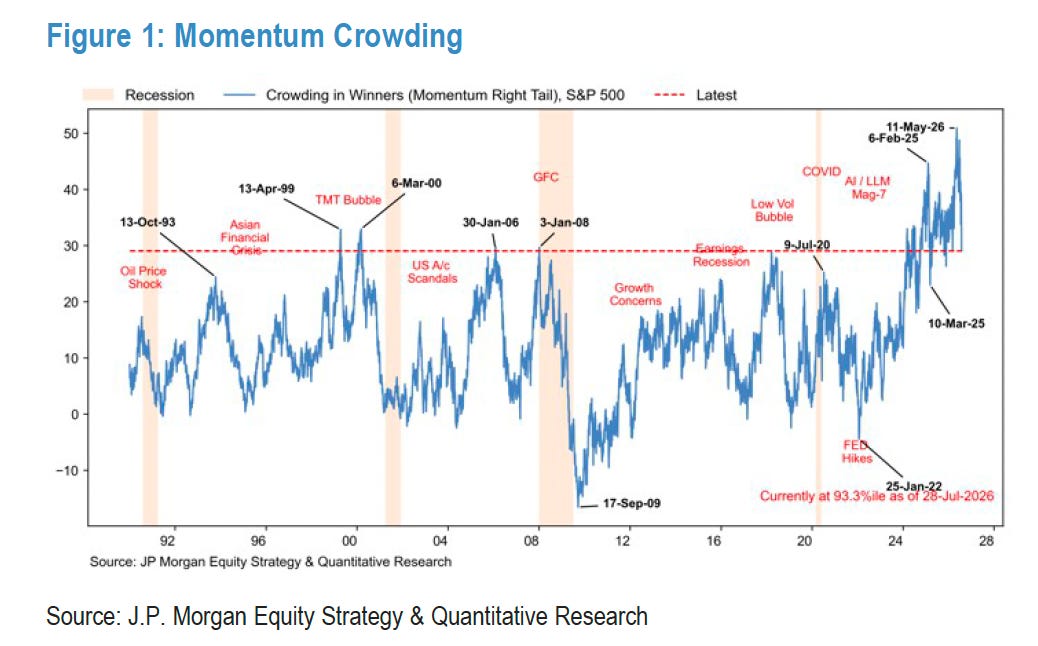
Parabolic bull markets almost always resolve in prolonged bear markets. The more extreme sentiment, price, and leverage get to the upside, the bigger the hangover. When margin calls hit, that capital becomes impaired and rarely comes back. For the bull market to regain new highs, this impaired capital has to somehow be replaced with new capital and a fresh narrative - a repair process that takes a long time, if it happens at all.
Those holding out for a fresh narrative to reignite the AI bull market are in for a rude awakening. If anything, the narrative has gotten worse over the past few weeks. Chinese AI lab Moonshot released Kimi K3, a model that outperforms Claude Fable in Code Arena.
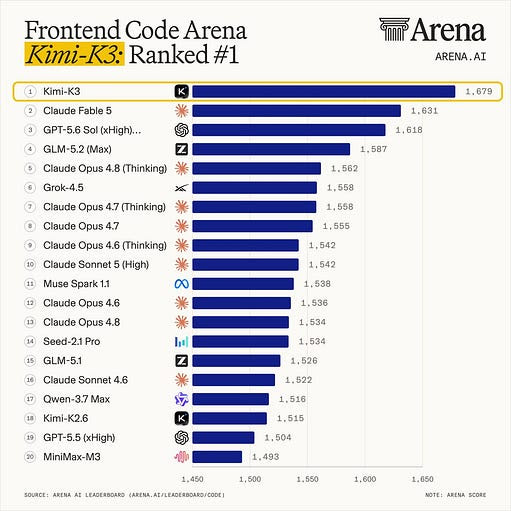
Alibaba is following in Moonshot’s footsteps with Qwen 3.8, a massive 2.4T open weight model. Sentiment is also shifting in favor of open-sourced models vs closed-source models, with Nvidia’s Jensen Huang being the latest AI luminary to support open-source.
Global macro maven Louis Gave once remarked “when China walks in, profits walk out”. This was true of EVs and solar panels, and the market now fears that competition from China will commoditize intelligence. All signs point to the cost of intelligence converging towards the cost of compute to serve it. Users can obtain similar performance from open‑source models for a fraction of the price of closed-source models, with better data privacy and no lock‑in, so it becomes hard to justify paying premium margins to OpenAI and Anthropic.
Cheaper intelligence is great for end users but horrible for the closed-source AI labs (OpenAI, Anthropic, Google) who have committed the enormous sums of capital to rent or purchase compute. As their margins and market share erode, their ability to raise capital at ever‑higher valuations suffers. That, in turn, undermines their capacity to honor their compute commitments. OpenAI decided to delay their IPO until next year, probably due to their lack of confidence in achieving a $1T valuation. Space X’s selloff to $112, 27% below its IPO price, is likely denting their IPO prospects even further. OpenAI and Anthropic act as a single points of failure in the entire AI sector due to their circular deals with other players in the ecosystem.
The coming compute glut
AI bulls point to an ongoing shortage in AI compute and components such as memory and optical networking, but this reasoning is misguided. Every commodity trader knows that supply shocks and bottlenecks feel the most acute at the top of the bull market. By the time supply and demand rebalance, the bull market has usually reversed completely. In many cases, the shortage turns into a glut, resulting in a prolonged bear market.
With the amount of compute that neoclouds and hyperscalers have committed to or started construction on, I wouldn’t be surprised if there is a glut of compute 1-2 years from now.
It’s entirely possible for a shortage of compute to turn into a glut while token consumption and AI model revenues to continue to growth at a rapid pace. Improvements in hardware and AI algorithms are delivering efficiency gains faster than users can increase consumption of tokens, resulting in overall token expenditure to decrease from levels in June. Silicon Data’s token expenditure index shows overall spending on tokens peaked in June and has been trending lower ever since.
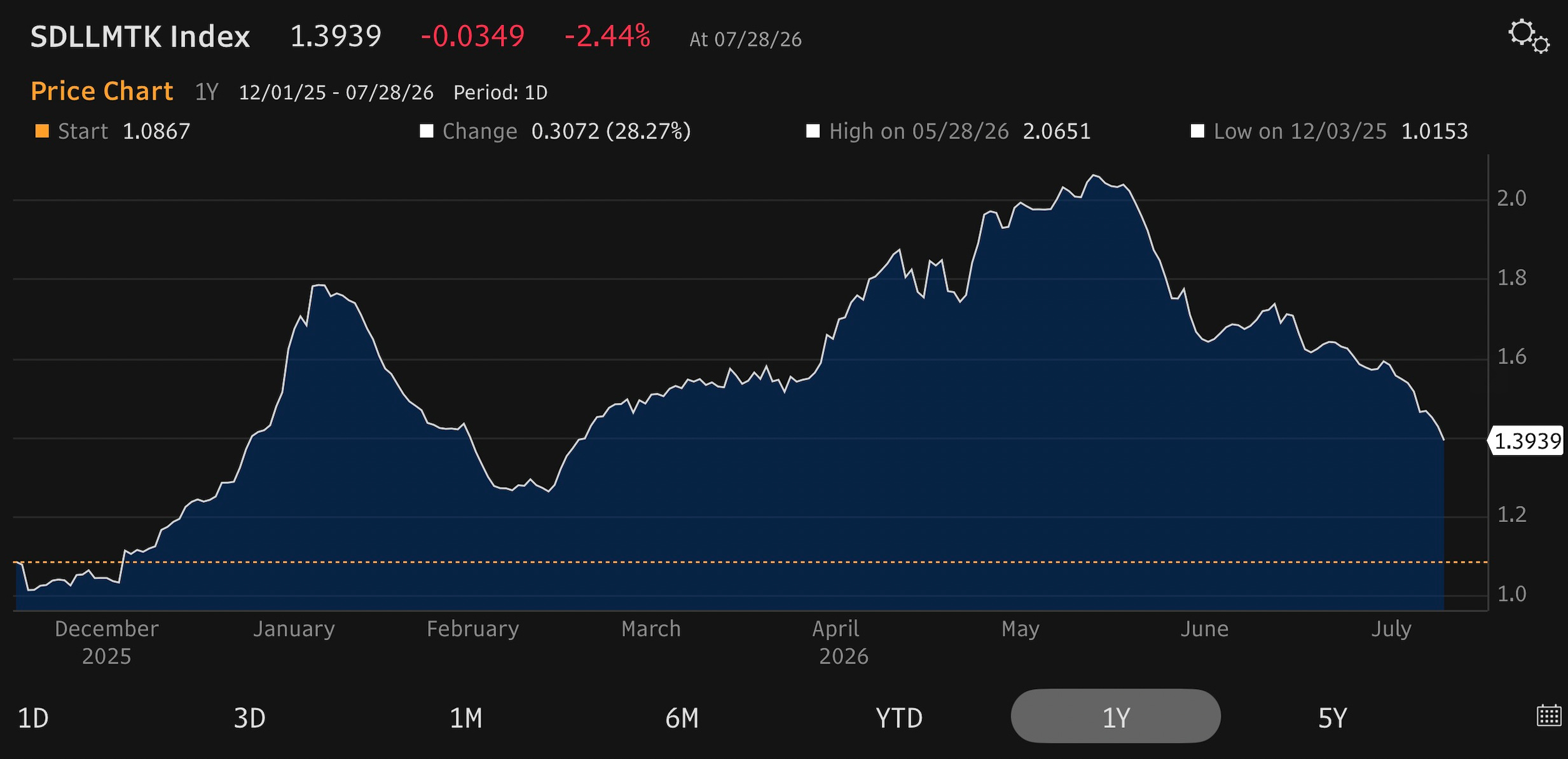
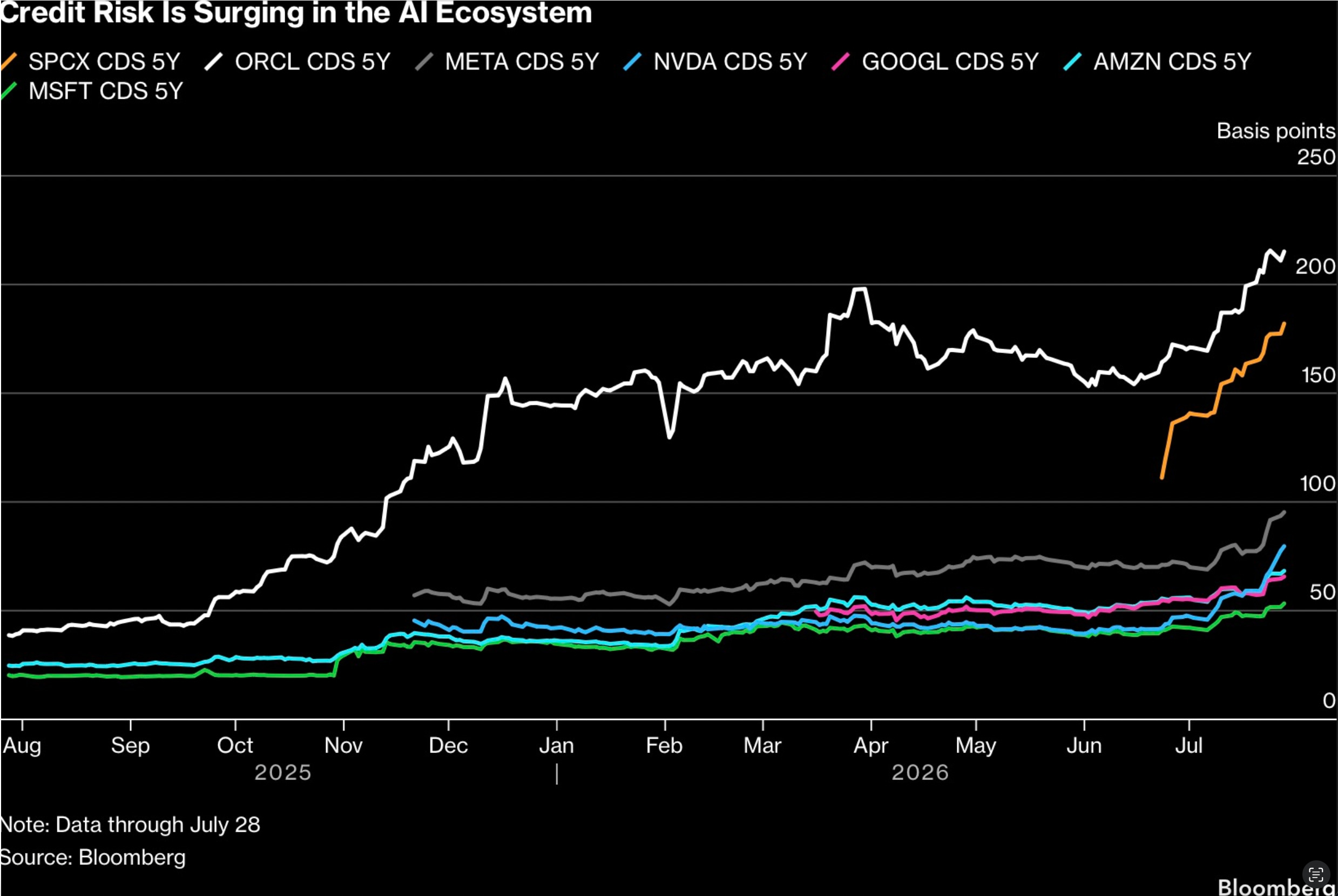
What would a glut of compute look like? Unfinished data centers, reneged commitments, and in some cases, debt defaults. It may get ugly. The corporate bond spreads of data centers and hyperscalers are signaling that the exorbitant investment into compute is becoming a riskier business decision.
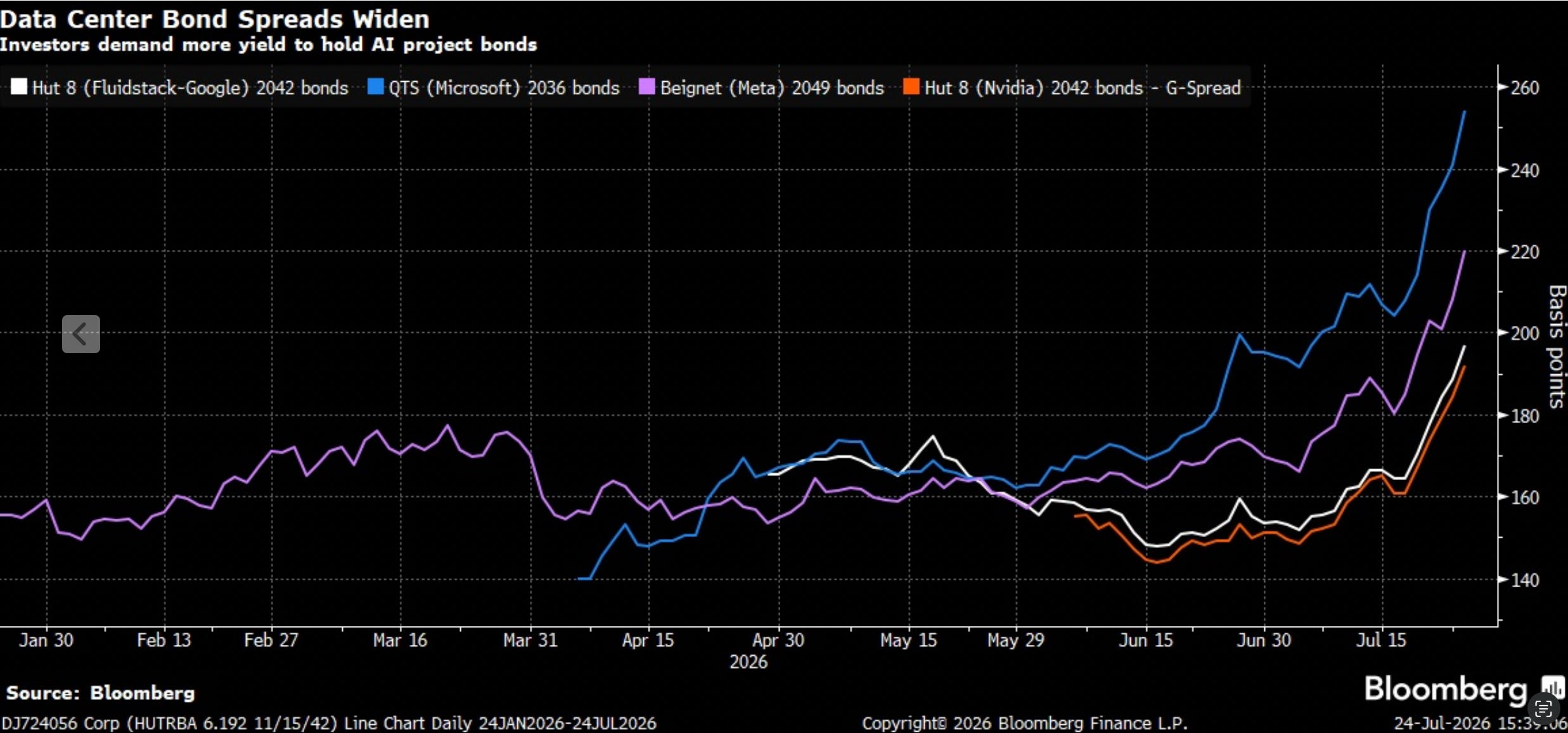
The stock market is not rewarding hyperscalers for announcing more AI capex, yet they are ignoring the signal and continue to ramp up spending.
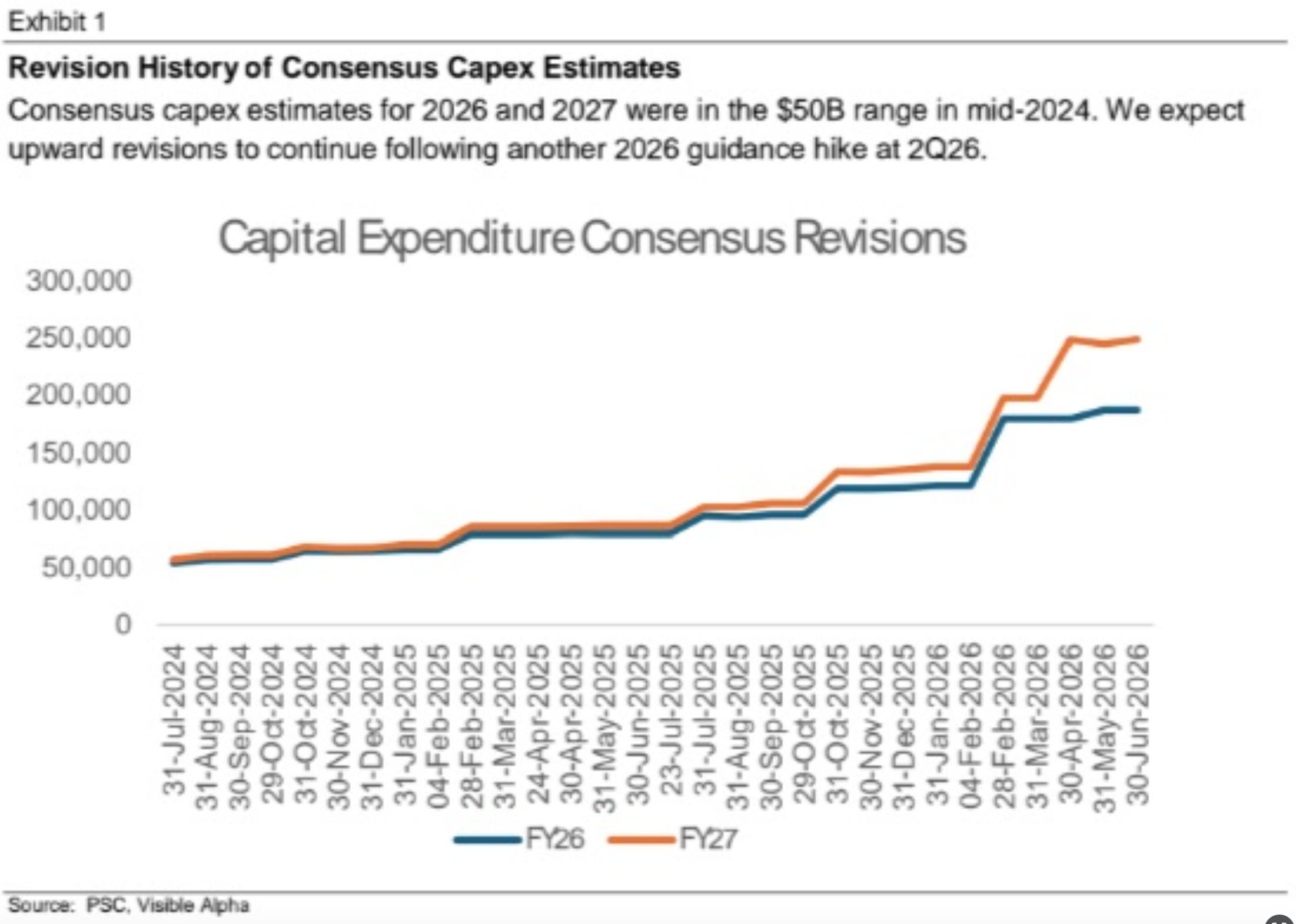
When Google announced that it would increase 2026 AI capex from $195B to $205B, its stock dropped 7%.
I know, it’s hard to envision such a bleak scenario happening, but recent history offers reminders. When the Strait of Hormuz closed in April, few expected oil to be back at $70 so quickly. When silver traded at 120 dollars in January, very few imagined it would fall to 55 within a year. In 2021, almost nobody believed that the high‑flying growth names of that bull market would be down 80 to 90 percent the following year. Shortages can flip to gluts quickly, and positioning can turn just as fast.
Iran - the next forever war
I previously thought the war in Iran would have limited long‑term impact on equity markets, but my views have evolved. The conflict is shaping up to be an on again, off again quagmire. The hardliners in Iran have no intention of giving up their two sources of leverage - their stocks of enriched, weaponized uranium and their stranglehold on the Strait of Hormuz. It will take a protracted ground war to wrest these from Iran’s control, and even then the chances of success are questionable. The war also has the potential to morph into a proxy war between US and China.
The Department of War estimates that the war has cost US taxpayers $37.5B so far, but this is likely an underestimate that doesn’t take into account the economic toll and the future spending required to restock equipment and munitions back to pre-war levels. The fact that Trump managed to drag his country into a costly, open-ended war without Congressional approval will go down in history as one of the clearest examples of how broken US democracy has become.
The world has seen four inflationary shocks in the last six years (covid, Russia-Ukraine, Trump tariffs, and the Strait of Hormuz). All of them resulted in a tightening of monetary policy and a severe drawdown in the market. The war in Iran may end up being the most persistent stagflationary force in the economy as it is affects the global supply of energy and goods and increases the cost of borrowing for the government.
Warsh’s Fed
Kevin Warsh is trying to overhaul how the Fed measures inflation and responds to inflation and how it communicates to the public in the middle of a supply shock and a deflating bull market in AI. This is akin to replacing all the parts of an airplane while flying through a storm.
With inflation above target and budget deficits widening, Warsh faces two bad choices. He can tighten early and flatten the yield curve, which risks a recession. Or he can delay tightening and let the long end of the bond market do the work. For now, he appears to be choosing to delay.
In yesterday’s FOMC meeting, the Fed had the chance to put action behind Warsh’s hawkish rhetoric by hiking rates, but declined to do so. The bond market reacted by bear steepening violently, a signal that the Fed’s ability to control inflation is losing credibility. Joseph Wang pointed out how Warsh says he’s promising price stability and targeting inflation of 2%, but is also changing how the Fed measures inflation in ways that he can’t reveal. Without a clear framework, bond investors have nothing solid to anchor expectations, and volatility rises in a way that equity markets will find hard to digest.
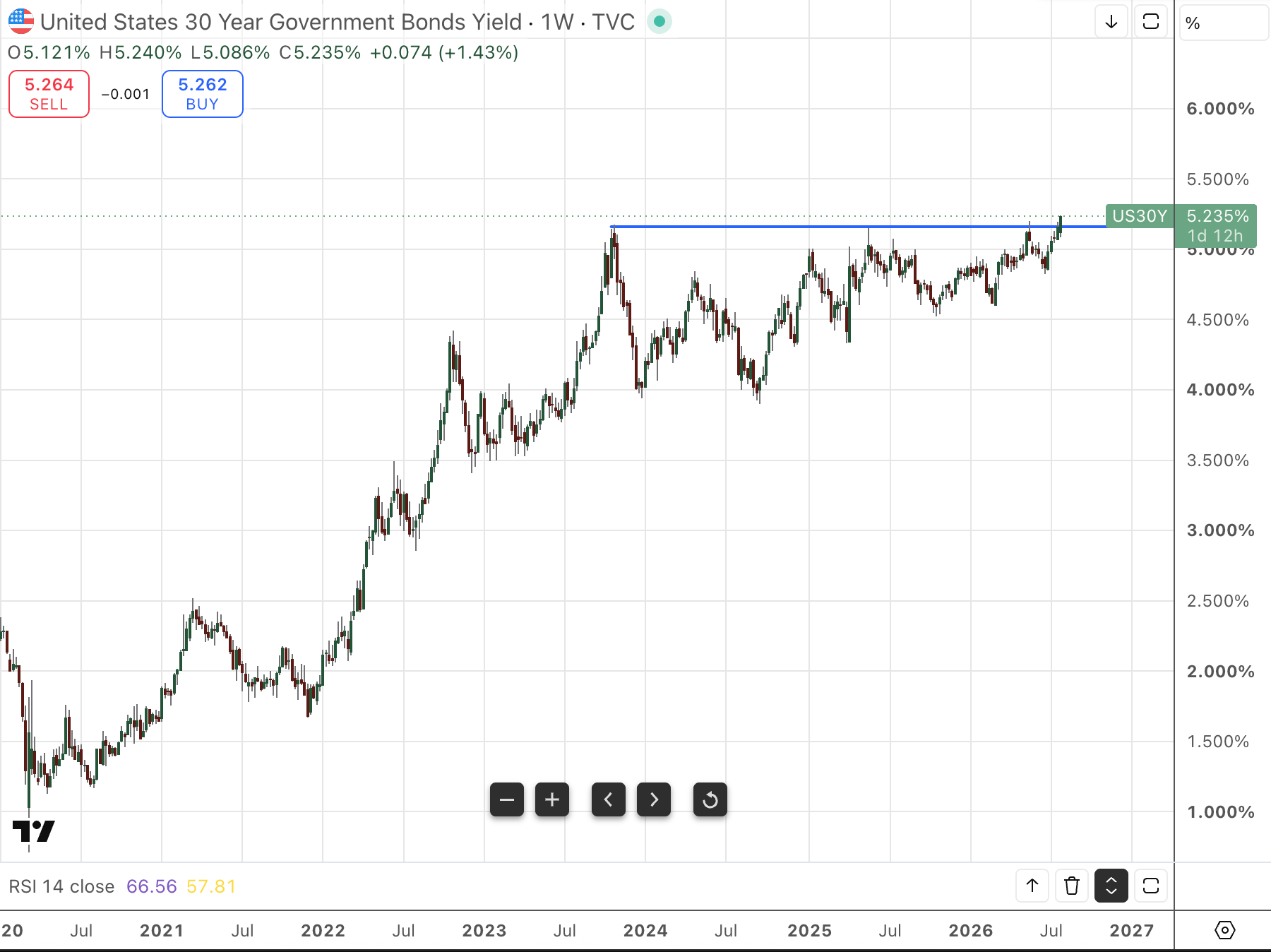
Long end yields are posting new highs above 5.2% after remaining stable for two years. This technical break ushers a new phase in the Treasury bear market and provides a new headwind for the equity markets to overcome.
Disclaimer: The content of this newsletter is provided for informational and educational purposes only and should not be construed as professional financial advice, investment recommendations, or a solicitation to buy or sell any securities or instruments. The newsletter is not a trade signaling service and the author strongly discourages readers from following his trades without experience and doing research on those markets. The author of this newsletter is not a registered investment advisor or financial planner. The information presented on this newsletter is based on his own research and experience, and should not be considered as personalized investment advice. Any investment or trading decisions you make based on the content of this newsletter are at your own risk. Past performance is not indicative of future results. All investments carry the risk of loss, and there is no guarantee that any trade or strategy discussed in this newsletter will be profitable or suitable for your specific situation. The author of this newsletter disclaims any and all liability relating to any actions taken or not taken based on the content of this newsletter. The author of this newsletter is not responsible for any losses, damages, or liabilities that may arise from the use or misuse of the information provided.